
Coupling Should Be Weighed, Not Counted

A balance scale where a single heavy weight outweighs many smaller pieces — illustrating that one heavy dependency can matter more than many lightweight ones.

“Words should be weighed, not counted.” — A Yiddish Saying

Static code analysis tools count dependencies, calculate ratios, and assign neat scores. Yet in my experience, chasing those metrics never really made the design more modular. It’s so easy to game the scores without any improvement to the design itself. Let’s see why, and what you can do instead.

The Counting Approach

Most static analysis tools evaluate coupling by counting dependencies. Afferent coupling (Ca) counts how many components depend on yours. Efferent coupling (Ce) counts how many components yours depends on. A popular instability metric combines them into a neat formula:

I = Ce / (Ce + Ca)

The higher the ratio of outgoing to total dependencies, the more “unstable” a component is considered. Simple. Automatable. And deeply misleading.

[Read More]
Just Launched: coupling.dev

coupling.dev

One of the most common pieces of feedback I received about Balancing Coupling in Software Design was that readers wanted a resource they could easily share with colleagues—a quick way to introduce the balanced coupling model and make discussions about it more accessible.

To meet that need, I created coupling.dev, a website that distills the core concepts of balanced coupling and related models into concise, approachable posts. It also serves as a hub for other learning resources, including conference talks and podcast appearances, helping teams streamline adoption and deepen their understanding together.

[Read More]

The Essence of Coupling and Cohesion in Under 500 Words

Integration Strength and Distance

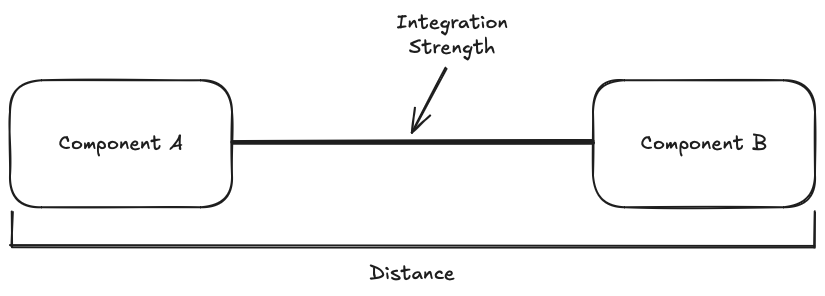
When you couple two components, they need to share some form of knowledge: public interfaces, functional behavior, implementation details, or other types of information. Let’s call it the integration strength. The more knowledge is shared, the stronger the integration. The stronger the integration, the more both components will have to change together. Therefore, you should always look to minimize the integration strength. That said, minimizing integration strength isn’t always possible—sometimes, extensive shared knowledge is necessary. For example, when the components implement closely related business functionalities.

Another important property of integrated components is the distance between them. For example, objects in a module are located closer to each other than the source code of two microservices. The greater the distance, the higher the induced cognitive load and coordination challenges, and the more effort is needed to change the integrated components simultaneously.

Now let’s examine four extreme combinations of the two dimensions:

[Read More]

Balancing Coupling in Software Design🎉

Frist of all, today is the 🐒 book’s birthday! 🎉

Exactly three years ago, Learning Domain-Driven Design was published! And what a birthday present the monkey received: today marks the official release of Balancing Coupling in Software Design! The new book is available in print and electronic formats on Amazon, InformIT, and other major book stores 🎉

Learning Domain-Driven Design's third anniversary

[Read More]